Blogs
Comparing Inflatable and Hard Paddle Boards: Best Stability for Beginner Mountain Surfing
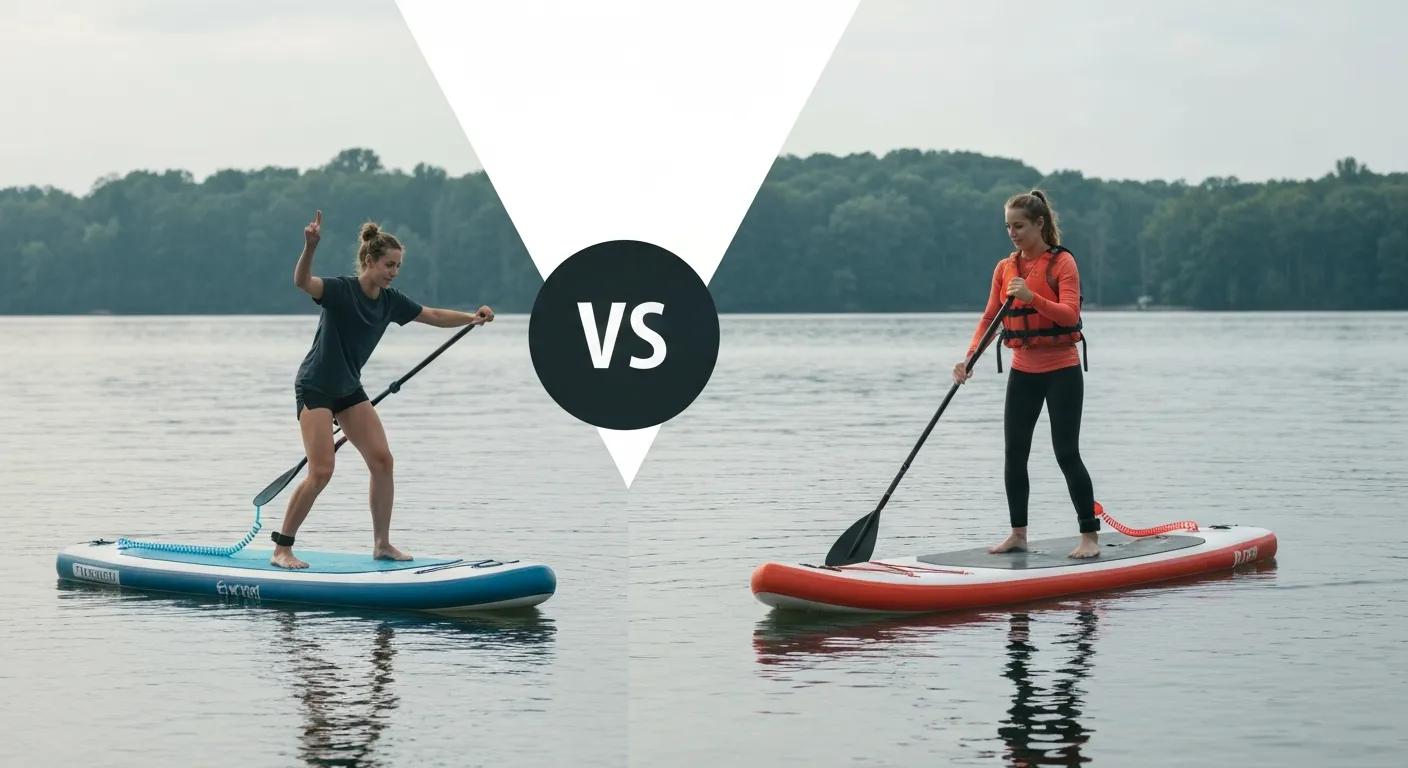
Inflatable vs. Hard Paddle Boards: Stability for Beginners
Mountain surf paddle boarding in alpine lakes and gentle rivers demands a clear choice between inflatable and hard (solid) paddle boards—each uses distinct construction and hydrodynamic mechanisms that affect initial and dynamic stability. This article explains how width, thickness, hull type, and fin configuration interact with board construction to produce stability outcomes specifically for beginner mountain surfing. Readers will learn which board features deliver the easiest learning curve on calm mountain lakes and in mild river currents, how environmental variables like wind and cold water affect handling, and pragmatic package choices for transport and safety. The goal is practical: help a beginner choose and test a stable board that minimizes tipping, maximizes confidence, and fits mountain access logistics. The guide maps key differences, the stability attributes that matter most, mountain-specific recommendations, model-type guidance, hands-on balance drills, common beginner questions, and how to assemble a starter package with appropriate accessories. Begin with the comparison of inflatables versus hard boards to establish which type tends to offer better stability for novices in mountain surf conditions.
What Are the Key Differences Between Inflatable and Hard Paddle Boards for Beginners?

How Do Inflatable Paddle Boards Offer Stability and Portability?
Inflatable Stand Up Paddle Boards (iSUPs) create stability through high-volume drop-stitch cores that, when inflated to recommended PSI, produce a stiff, buoyant platform with a forgiving deck surface. The drop-stitch construction binds opposing fabric layers with thousands of threads so high-pressure inflation yields plateau-like stiffness and consistent lateral support, which benefits static balance for new paddlers.
Inflatable decks are softer on impact, reducing fear of hard falls and encouraging repeated practice in small surf and shoals typical of mountain waters. Portability is a major advantage: rolled or packed iSUPs fit into backpacks or car trunks, removing roof-rack constraints and enabling remote lake access. This portability leads directly into the hard-board trade-offs beginners should weigh next.
What Stability Advantages Do Hard Paddle Boards Provide for Mountain Surfing?

Hard (epoxy/fiberglass) boards provide a rigid hull that translates paddler inputs into precise glide and quicker responses to edging and trim, which helps in small waves, chop, and current transitions common in river eddies. The rigid shell keeps rocker and rail contours true under load, improving dynamic stability during paddling strokes and when leaning into a turn; this responsiveness supports learning advanced balance and edging techniques.
Conversely, hard boards are less forgiving on impact and require careful transport and storage to avoid dings that alter hydrodynamics. For beginners focused on learning in slightly more demanding moving water, the greater glide and tracking can reduce corrective stroke frequency, a benefit that contrasts with the portability trade-offs just discussed.
What Are the Pros and Cons of Inflatable vs. Hard Paddle Boards for Beginners?
Below is an objective pros/cons summary that clarifies beginner trade-offs in mountain-surf scenarios and helps match board type to access and goals.
Inflatable SUPs are highly portable, forgiving on falls, and durable against light rock impacts; they trade off ultimate speed and precise edge control.
Hard paddle boards offer superior glide, edge responsiveness, and faster acceleration but require dedicated transport, careful handling, and risk cosmetic/structural dings.
For many beginners on mountain lakes, portability and forgiving deck feel favor an iSUP, while novices aiming to progress into small surf or river play might opt for a stable hard board shape.
This comparison frames the practical recommendation: choose an inflatable if your priority is easy access and low anxiety on falls, and choose a stable hard board if you value performance and expect to practice edging and trim in moving water. The next subsection explores how material choices further affect these trade-offs.
How Does Board Material Affect Stability and Durability?
Board construction—PVC drop-stitch layers for inflatables and epoxy/fiberglass (often with EPS foam cores) for hard boards—directly influences stiffness, weight, and puncture/ding behavior, which in turn modify both static and dynamic stability. PVC drop-stitch iSUPs become stiffer at higher PSI, so a higher-rated board inflated to spec delivers stability closer to a hard board while retaining softer fall characteristics; the valve, seam bonding, and outer laminate quality determine long-term stiffness retention.
Epoxy/fiberglass boards provide a high stiffness-to-weight ratio and maintain hull shape under varied loads, improving dynamic balance and tracking, but even minor dings can alter rail flow and create instability unless repaired. Maintenance practices differ: patch kits and careful inflation preserve iSUP performance, while ding repairs and storage reduce damage risk for hard boards. Understanding these material effects clarifies why width, thickness, and hull type matter next.
Which Paddle Board Stability Factors Matter Most for Beginner Mountain Surfers?
How Does Board Width Influence Stability on Mountain Lakes and Rivers?
Board width governs initial lateral stability: a wider deck increases the moment arm between the rider and waterline, making small weight shifts less likely to cause a tip. For beginners, a practical width band is roughly 30–34 inches; narrower boards enhance maneuverability but demand more active balance, while boards wider than 34–36 inches can hinder turning in tight river channels. Rider weight and carried gear change the effective stability envelope—heavier paddlers or those bringing a dog or pack should move to the upper end of the width range to maintain flotation and balance. In mountain lakes where turning room is abundant, choose wider profiles for confidence; in narrow river runs, balance width with the need to pivot quickly. This width guidance leads directly to the role thickness plays in buoyancy and load-carrying.
Why Is Board Thickness Critical for Buoyancy and Balance?
Thickness correlates with total volume and flotation: thicker boards (commonly 4.7–6 inches for iSUPs) increase buoyancy, lower the board’s trim under load, and make maintaining a centered stance easier for beginners. A typical beginner thickness recommendation is 5–6 inches, which supports rider weight plus modest gear without sinking the rails and reducing lateral stability. For inflatables, effective thickness also depends on PSI; underinflated boards feel softer and less stable, while properly inflated boards approach intended stiffness and flotation. Thickness interacts with width: a narrower but thicker board can match the buoyancy of a wider, thinner design, so evaluate volume ratings when matching board size to rider weight. Thickness considerations naturally segue into hull type choices that affect stability in motion.
What Role Does Hull Type Play in Beginner Stability?
Hull type—planing versus displacement—dictates how a board reacts at low and high speeds: planing hulls have flatter bottoms that create early lift and broad initial stability ideal for beginners practicing balance and quick maneuvers in lakes and rivers. Displacement hulls use tapered, rounded underbodies that track efficiently and cruise at speed but offer less initial, side-to-side stability for a novice learning balance. For most mountain-surf beginners, a planing hull or an all-around hybrid provides the best learning platform because it reduces bobbing and allows easier recovery from wobble. Choose a planing or all-around hull if learning in small surf or choppy lake conditions; consider a displacement hull only if long tours and pure tracking efficiency are the priority. Hull selection informs fin configuration decisions covered next.
How Do Fin Configurations Affect Tracking and Stability?
Fin setup alters tracking, turning, and lateral resistance: a large center fin increases straight-line tracking and perceived stability by resisting lateral slip, while thruster (three-fin) setups add maneuverability and hold in small surf but can feel less stable in a straight line. Removable fin systems allow beginners to test configurations—using a larger single center fin for initial lessons then adding side fins for maneuverability practice. In rivers, a slightly smaller center fin reduces the chance of catching on rocks while maintaining adequate tracking; in lakes, a larger center fin helps maintain course with fewer corrective strokes. Consider fin depth and base width as tunable parameters for stability: deeper fins improve grip but can snag in shallow rocky runs. These fin choices bring us to a concise table summarizing key board attribute ranges for beginners.
AttributeTypical Beginner RangeWhy It MattersWidth30"–34"Wider decks increase initial lateral stability and confidence.Thickness5"–6"More thickness raises volume and flotation for easy balance.Length9'–11'Shorter lengths aid maneuverability in rivers; mid-lengths balance speed and stability.Volume220–320 L (varies by weight)Matches rider weight + gear to keep rails out of water for stability.
How Do Mountain Surfing Conditions Affect Paddle Board Stability Needs?
What Stability Features Are Best for Calm Mountain Lakes?
Calm mountain lakes reward boards that maximize initial stability and comfort: wide decks, soft yet grippy deck pads, and a larger center fin for straight tracking help new paddlers build confident strokes without frequent corrective moves. All-around iSUPs in the 31"–34" range with a full-length deck pad provide secure footing for standing drills and slow paddling progression. Low-wind mornings and shore-based entry points reduce environmental variables, so beginners should time sessions for flat conditions and short practice circuits near the shore. Soft deck materials and ankle leashes further soften falls and speed recovery, enabling faster repetition and skill acquisition. Understanding calm-water setups helps when transitioning to gentle river conditions described next.
How Should Beginners Choose Boards for Gentle River Currents?

Gentle river currents require balance between tracking and maneuverability, plus durable construction to withstand occasional rock contacts; moderate-width boards (30"–32") with reinforced rails or tougher laminated iSUP layers are a pragmatic choice. Fin setup should favor a removable or slightly smaller center fin to reduce snag risk while preserving directional stability for downstream paddling; thruster options help when negotiating eddies or performing quick pivots. Entry and exit techniques—carrying the board down shallow banks, launching downstream of obstacles—directly reduce instability risk and speed recovery. Prioritize a package that includes a durable leash, reliable pump, and a low-profile fin system to handle river variability and minimize turnover.
What Environmental Factors Impact Stability in Mountain Waters?
Wind, water temperature, and altitude subtly alter perceived stability: wind-driven chop increases corrective stroke demands and can overturn a board that performs exceedingly well in still water, while cold water increases immersion risk and makes wearing appropriate flotation and exposure protection essential. Altitude has minor buoyancy effects but mainly reduces aerobic capacity, meaning beginners may tire faster and need more frequent rests, which affects balance maintenance. Mitigations include choosing low-wind windows, wearing a suitable PFD and wetsuit, and shortening session durations at higher elevations. These environmental considerations guide the selection of model types and package components discussed next.
What Are the Best Paddle Board Models for Beginner Stability in Mountain Surfing?
Which Inflatable SUP Models Are Recommended for Beginner Stability?
When evaluating inflatables for beginner stability, prioritize double-layer drop-stitch constructions rated for higher PSI, mid-range widths (31"–34"), and long, grippy deck pads that support a centered stance. Look for boards that specify reinforced rails and a removable center fin so you can modulate tracking as you practice; boards with included repair kits and pump systems simplify mountain trips. Demo or rental options should let you test recommended PSI levels—higher inflation improves stiffness and thus stability—so insist on trying the board fully inflated before purchase. These feature-driven criteria ensure an iSUP delivers both the forgiving deck feel and the stiffness necessary for stable beginner mountain surfing.
What Hard Paddle Boards Offer Superior Stability for Beginners?
For hard boards, seek stable shapes with flatter center sections, broader noses and tails, and modest rocker profiles that favor initial stability over aggressive surfing performance. Epoxy or fiberglass constructions with solid rail geometry maintain predictable edge control and reduce sudden roll underfoot, which is valuable when learning edging and lean-based balance. If transport is a constraint, consider modular carrying solutions—soft racks or padded carriers—to reduce the barrier to choosing a stable hard board. Inspect construction quality carefully when demoing, and prioritize thicker rails and deck pads to increase comfort and reduce the psychological barrier to falling.
What Features Should Beginners Prioritize When Choosing a Stable Paddle Board?
To simplify purchasing decisions, prioritize a short feature checklist that addresses the core drivers of beginner stability: width, thickness/volume, deck traction, fin compatibility, and leash/PFD compatibility. Confirm recommended rider weight/volume match, check inflation/stiffness specs for iSUPs, and ensure the deck pad offers full-foot placement options for stance progression. Also prioritize repairability and included accessories—pump, leash, and fin keys—which increase readiness for mountain outings. Use this checklist at rentals and demos to compare models objectively.
Model TypeStability FeatureWhy it Helps in Mountain ConditionsAll-around iSUP31"–34" width, high-PSI drop-stitchBalances portability with strong initial stabilityTouring/stable hard boardFlatter center, wider nose/tailBetter glide and edge control for small waves and currentsHybrid planing boardModerate rocker, full deck padVersatile for both lakes and gentle river play
These model-type characteristics guide demo evaluations and support the accessory and package decisions addressed next. After considering models, curated local accessory bundles can complement any stable board choice.
For complementary gifts or practical add-ons, consider locally made accessories that enhance transport and storage while celebrating regional craft: handcrafted wooden paddle grips, carved paddle handles, or artisan bungee tie-downs designed for boards. Mountain Surf Paddle Sports showcases Appalachian fine arts and handmade crafts created by local artisans and can Showcase and Sell Handmade Goods appropriate as durable, aesthetic accessories for paddlers. These artisan pieces pair well with stable board packages and make practical gift bundles for beginners building confidence on mountain waters.
How Can Beginners Master Stability Techniques for Mountain Surf Paddle Boarding?
What Basic Paddling Techniques Improve Balance and Control?
Mastering stroke fundamentals stabilizes the board by creating consistent forward momentum and minimizing lateral wobble: use a long, smooth reach forward, plant the blade fully, pull through with a steady torso rotation, and exit the blade cleanly near the ankle line. Longer, lower-cadence strokes reduce abrupt lateral forces that cause wobble and help maintain a predictable trim, while short corrective strokes recover direction without excessive upper-body lean. Practice drills in calm water—straight-line paddling, staggered single-stroke recovery, and slow 180-degree turns—build muscle memory for balance. These stroke fundamentals set up the body-positioning techniques described next.
Rider Stability on Stand-Up Paddle Boards: Dimensions and Skill Level
This study investigates the rider stability on a stand-up paddle board (SUP) based on board dimensions, rider body parameters, and skill level using a buoyant body dynamics approach. For this study, the system of a rider standing on an SUP is modeled as a planar motion of a rectangular cross-sectional buoyant body with an added mass attached at a fixed height. A stability map is developed to visualize stability regions for various system parameters. The result shows that eigenvalue contours are in good agreement with qualitative terms, such as beginner and professional. A new approach of describing rider skill level is proposed. Wave tank experiments are conducted to verify the analytic equations. Analytical results of the rectangular board show the same trend as the experimental results from a real SUP product.
Stability of coupled human and stand-up paddle board, BP Mann, 2018
The following drills focus on repeatable mechanics and can be done in short sessions: Long-stroke repeat: 10 strokes per side focusing on full plant and torso rotation. Single-leg balance: kneel then stand, lift one foot briefly to test micro-balance. Figure-eight turns: slow controlled turns to practice trim and edge control.
Use these drills progressively and end each session with a short stability checklist to consolidate learning.
How Can Beginners Use Body Positioning to Enhance Stability?
Effective body positioning centers weight over the board’s midline and lowers the center of gravity when necessary: keep feet shoulder-width on the deck pad, knees slightly bent, and eyes on the horizon rather than the nose. Micro-adjustments—shifting weight toward the rail to counter a lean or stepping slightly toward the stern to reduce nose dive—are learned through repetitive drills and deliberate edging practice. Use the paddle as a brace by planting it on the water to arrest a wobble, and practice quick recovery sequences where you kneel, regain balance, then stand in one fluid motion. These positioning techniques integrate with safety practices presented next.
What Safety Tips Help Maintain Stability on Mountain Waters?
Safety practices preserve stability and confidence: always wear an appropriate PFD, use a leash suited to the water type (coiled for lakes, straight for rivers where snagging risk is managed), and dress for immersion in cold water with a wetsuit or insulated layers. Plan launches to avoid rocks and steep banks, scope out entry/exit points, and paddle in low-wind windows to reduce chop. Carry a basic repair kit for inflatables and a pump rated for your board’s PSI when using iSUPs, and practice self-rescue drills so that falls become learning moments rather than stressors. These safety measures make stability training more productive and enjoyable.
What Are Common Beginner Questions About Paddle Board Stability?
Are Inflatable Paddle Boards More Stable Than Hard Boards?
Yes and no—iSUPs are often more stable initially due to greater volume and softer deck response, which makes them easier for a first stand and reduces fear of falling; however, hard boards can outperform inflatables in dynamic stability during moving water because rigidity preserves hull shape under load. The practical answer: for initial learning in calm mountain lakes, an inflatable usually feels more stable; for progressing into edged turns and small river features, a hard board’s responsiveness may offer better control. Match your choice to access logistics and learning goals, then test via rentals or demos before committing. For more personalized advice, feel free to contact us.
What Size Paddle Board Is Best for Beginner Stability?
Choose size based on rider weight and goals: a 9'6"–10'6" length paired with 31"–34" width and 5"–6" thickness suits most beginners up to average adult weights, while riders carrying gear or heavier loads should increase volume accordingly. Use the board’s volume rating as the primary matching metric and allow at least 50–70 liters above your body displacement to ensure rails stay free and the board remains forgiving. Always test a board inflated to recommended PSI or demo a hard board on the water to confirm comfort and balance before purchase.
Is a Wider Paddle Board Always More Stable for Beginners?
Wider boards increase initial lateral stability, but there are diminishing returns: beyond a certain width, a board becomes harder to pivot and less responsive, which can impede learning efficient stroke mechanics. Beginners focused on yoga or stationary balance may prefer very wide decks, while those wanting to learn river maneuvers need a compromise width to preserve turning ability. A practical approach is to choose the widest board that still allows comfortable edging and controlled turns in your intended mountain environment.
What Is the Most Stable Type of Paddle Board for Mountain Surfing?
For most mountain lake and gentle river beginners, a planing-hull all-around iSUP in the 31"–34" width and 5"–6" thickness band offers the best blend of initial stability, portability, and forgiving handling. If your priority is progressing quickly into small surf and edged maneuvers, a stable hard board with a flatter center and wider tail will provide better dynamic performance. Use the checklist in the following section to assemble a starter package that supports your chosen board type and local conditions.
How to Choose the Right Paddle Board Package for Beginner Mountain Surfing?
What Should a Beginner Paddle Board Package Include for Stability?
A complete beginner package should include the board matched to rider volume, an adjustable paddle sized to your height, a leash appropriate to water type, a reliable pump and gauge for iSUPs, and an appropriate PFD for safety and flotation. Non-slip deck pads provide traction for confident foot placement and reduce slip risk during recoveries, while bungee storage keeps essential gear secure on varied launches. Optional but valuable items include a repair kit, a compact carry pack for inflatables, and protective rail padding for transport. Importantly, the package can also incorporate locally made accessory items that pair utility with craft heritage.
The site’s raw content mandate aligns with local craft promotion: Mountain Surf Paddle Sports Showcase and Sell Handmade Goods that complement paddle board packages, offering artisan-made straps, carved paddle grips, and handcrafted board racks suitable as gifts or practical accessories for paddlers. These handmade additions enhance portability and celebrate regional craftsmanship while supporting beginner stability through better gear handling.
Package ComponentBenefitPractical NoteBoard (matched volume)Primary stability and flotationConfirm rider weight + gear capacityAdjustable paddleEfficient stroke mechanicsMatch blade size to stroke and strengthLeash & PFDSafety and immediate recoveryChoose leash style by water typePump + repair kitMaintain iSUP stiffness and readinessCarry spares for remote launches
How Does Portability Influence Package Choice for Mountain Adventures?
Portability dictates whether an iSUP or hard board is the pragmatic choice: iSUP packages compress into backpacks and fit most small vehicles, enabling access to backcountry lakes and trailhead launches; hard boards demand roof racks or vehicle racks but can offer superior performance once transported. Consider your typical access—if frequent hikes to launch points are likely, prioritize a lightweight iSUP package with a durable carry pack and local artisan tie-downs; if you have consistent vehicular access and storage, a stable hard board package may be preferable. Portability affects not only board selection but accessory choices like pump type, leash style, and fin systems.
Where to Buy Stable Beginner Paddle Boards for Mountain Surfing?
When sourcing a board, prioritize retailers or rental programs that allow on-water demos, have clear return or exchange policies, and provide basic repair or service options for both iSUPs and hard boards. Local outfitters and community co-ops often provide terrain-specific advice for mountain lakes and rivers and can help you trial recommended width/thickness combinations. Mountain Surf Paddle Sports focuses on community and craft connections and showcases Appalachian fine arts and handmade crafts created by local artisans—consider pairing a technical demo with locally made accessories to support resilience and regional makership. Test boards under real inflation and load to validate perceived stability before purchasing.
A concise beginner package checklist that is snippet-ready follows.
A beginner paddle board package should include: Board matched to rider volume and intended use. Adjustable paddle sized to your height and strength. Leash rated for lakes or rivers and an appropriate PFD. Pump with pressure gauge (for iSUPs), repair kit, and basic tools. Optional artisan accessories for transport, grip, or gifting.
Use this checklist to compare packages at rental counters, retailers or demo events and to evaluate which accessories enhance stability and transport for your mountain adventures.
For those assembling a gift bundle or starter pack, curated accessory ideas from local artisans—such as carved wooden paddle grips, hand-stitched board covers, or bespoke board racks—make practical and meaningful additions to the core package without undermining technical performance. You can explore these and other items on our products list.

Our Customers Say About Us


It is a long established fact that a reader will be distracted by the readable content of a page when looking at its layout. The point of using Lorem Ipsum is that it has a more-or-less normal distribution of letters, as opposed to using ‘Content here, content here’, making it look like readable English.
It is a long established fact that a reader will be distracted by the readable content of a page when looking at its layout. The point of using Lorem Ipsum is that it has a more-or-less normal distribution of letters, as opposed to using ‘Content here, content here’, making it look like readable English.
Questions?
Get in touch with our team.
304-470-SURF

Quick Links
© Copyright 2026. Mountain Surf Paddle Sports. All rights reserved.